
Conférence "Ln(III)-centered chiroptical activity from coordination compounds and inorganic matrices" par Silvia Ruggieri
Silvia Ruggieri, maître de conférences en chimie générale à l'université de Vérone, et invitée dans le cadre de l'action FABULEU du CIR ITPS, donnera le jeudi 19 mars à 15h une conférence afin de présenter ses activités de recherche.
Abstract:
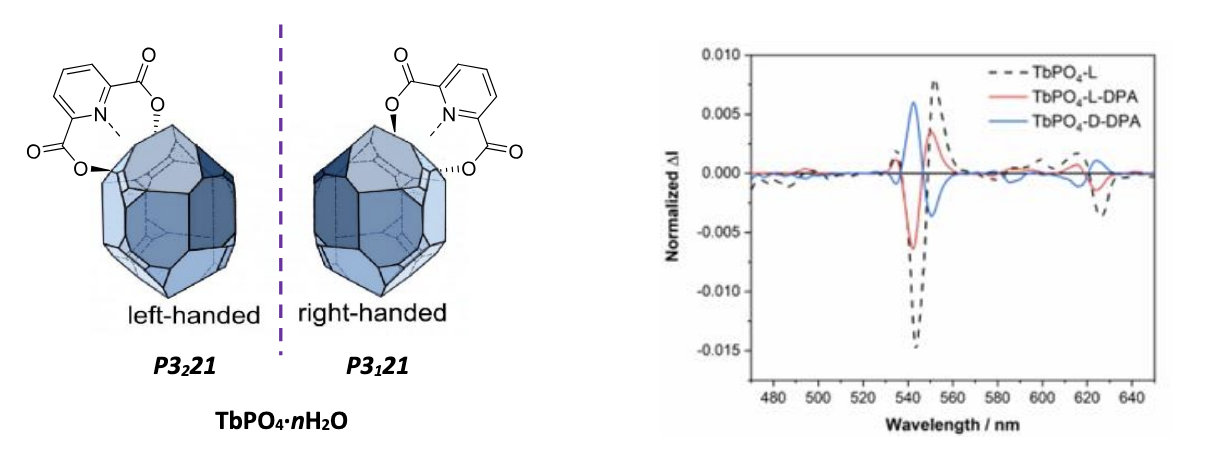
Circularly Polarized Luminescence (CPL) is gaining increasing interest in materials chemistry and physics thanks to the broad range of possible biological[1] and technological applications,[2] including the design of chiroptical phosphors for CPL-microscopy[3] and for CPL security devices or inks.[4] CPL activity in the visible spectral region, stemming from trivalent lanthanide ions, is usually obtained in the case of luminescent Ln(III) complexes [Ln = Tb (in the green) and Eu (in the red)] containing a non-racemic chiral ligand, but it can also be detected when these ions are embedded in inorganic matrices crystallizing in enantiomorphic space groups.[5,6] In this contribution, two examples of CPL active Ln(III)-based species are presented, the former related to Ln(III) complexes and the latter to enantiomorphic inorganic matrices capped with organic ligands to sensitize the Ln(III) luminescence (cf. Figure). Both these materials can be considered good candidates for advanced chiroptical applications.
"This work was supported by the International Research Center 'Innovation Transportation and Production Systems' of the I-SITE CAP 20-25."- FABULEU Project
______________________________________________________________________________________
[1] A.T. Frawley, R. Pal, D. Parker, Chem. Commun. 2016, 52, 13349-13352.
[2] F. Zinna, M. Pasini, F. Galeotti, C. Botta, L. Di Bari, U. Giovanella, Adv. Funct. Mater. 2017, 27, 1603719.
[3] P. Stachelek, L.E. MacKenzie, D. Parker, R. Pal, Nat. Commun. 2022, 13, 553.
[4] L.E. MacKenzie, R. Pal, Nat. Rev. Chem. 2021, 5, 109-124.
[5] U. Hananel, A. Ben-Moshe, H. Diamant, G. Markovich, Proc. Natl. Acad. Sci. U.S.A. 2019, 116, 11159-11164.
[6] L. Ceccon, E. Cavalli, S. Ruggieri, M. Bettinelli, F. Piccinelli, Inorg. Chem. 2024, 63, 13636-13643.
Short bio:
Dr. Silvia Ruggieri received the degree in Industrial Chemistry in 2015 and the PhD in Chemistry in 2019 at the the Alma Mater Studiorum, University of Bologna, under the supervision of Prof. Cristina Femoni, with a thesis about eterometallic Rh carbonyl nanoclusters. In 2020, she obtained a research fellowship at the University of Verona in the research group of Prof. Fabio Piccinelli working on luminescent properties of Ln(III) compounds. In 2017, she spent 6 months as visiting PhD student at the Ecole Polytechnique Fédérale de Lausanne (Switzerland) in the research group of Prof. Paul J. Dyson and in 2025 a short period as visiting researcher at the Department of Physics of University of Aveiro (Portugal) in the research group of the Prof. Luís. Carlos. Silvia Ruggieri has co-authored 35 scientific publications (articles and book chapters) on peer-reviewed international journals (496 citations; h-index 13. Scopus source). She presented 16 contributions (oral communications and posters) at national and international scientific conferences. She was also invited to hold seminars in Italian Universities. The main scientific interests of Dr. Silvia Ruggieri are focused on the synthesis and characterization of luminescent Ln(III) species and of carbonyl cluster compounds. She participated in research projects funded by European community and by Italian Ministry of the University and Research (MUR). Silvia Ruggieri is presently lecturer at the University of Verona of General chemistry and she has co-supervised one PhD student and several BSc and MSc theses in Inorganic Chemistry.